

Local government reorganisation
Local government reorganisation creates an immediate digital challenge. Councils that are merging need to present a coherent face to residents from day one of the new authority, often while legacy systems are still running and staff are adjusting to new structures. The window to get this right is narrow, and the consequences of getting it wrong — residents unable to find services, broken links, duplicated or contradictory content — fall on the people councils exist to serve.We have been through this with councils in Cumbria. We know what the pressure looks like from the inside.
What LGR means for your website
When two or more councils become one, the website question is more complex than it first appears. It is not just a matter of picking one site and redirecting the others. There are decisions to make about:
- Which content comes across and which is retired
- How to handle URLs so existing links do not break
- How staff from different predecessor authorities access and manage the new CMS
- Whether microsites for specific services need to be consolidated or maintained separately
- How to communicate clearly with residents about which authority is now responsible for what
These decisions need to be made quickly, with limited room for error, often against a statutory deadline that does not move.
How LocalGov Drupal helps
LocalGov Drupal is particularly well suited to LGR work. Because it is the same platform across an increasing number of councils, migrating content from one LocalGov Drupal installation to another is significantly more straightforward than migrating from proprietary systems. Shared code means new functionality built for one authority is available to others. And the community of councils and suppliers using the platform means there is real-world experience of exactly this kind of transition to draw on.
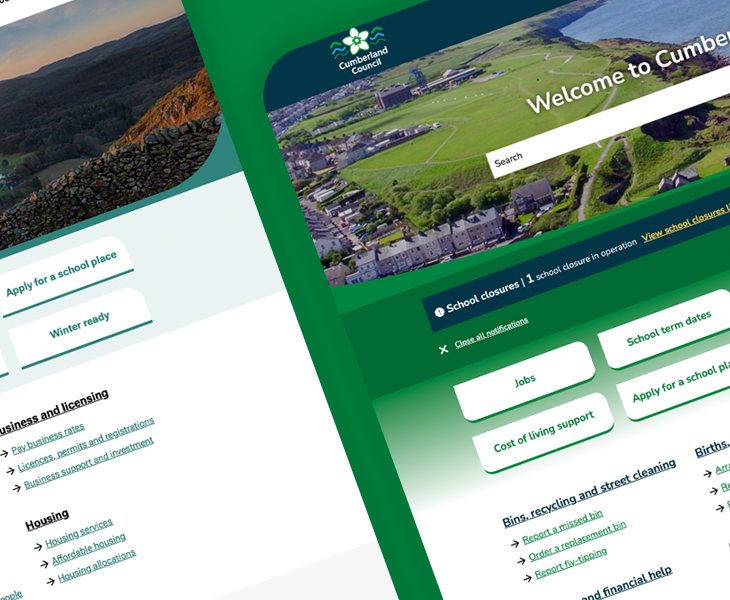
Where predecessor councils are on legacy platforms — as was the case in Cumbria — we use content migration tooling that automates much of the transfer process, saving months of manual work and reducing the risk of content being lost or duplicated.
How we work on LGR projects
LGR projects are not standard website builds. They have fixed deadlines, political visibility, and a level of organisational complexity that requires careful coordination across teams who may not yet have established ways of working together.
Our approach draws on strategy and consultancy to map the content and structure decisions early, content design to ensure the new site serves residents clearly through the transition, and technical delivery to execute the migration accurately and on time.
We are used to working as part of multi-disciplinary teams alongside your internal web officers, communications teams, and other suppliers. We get up to speed quickly and work to your timeline, not ours.
The broader context
The English Devolution White Paper, published in December 2024, confirmed that local government reorganisation will accelerate significantly across England. Councils that have not yet begun planning their digital transition need to do so now — the timelines involved in a well-executed migration are longer than most people expect.
We have written a series of articles on the digital implications of LGR and devolution that may be useful starting points.